Guides & frameworks for product managers
Free guides, definitions, and frameworks to help you become a better product manager. From writing your first PRD to leveraging AI in your workflow.
22+ free guides · Trusted by 250k+ PMs
What’s inside
- Product Management7 guides
- Templates & Frameworks2 guides
- AI for PM8 guides
- PRDs for AI Software Engineering5 guides
Product Management

Different forms of product documents & alternatives to PRDs
Product documentation varies based on team needs and project goals, ranging from traditional Product Requirements Documents (PRDs) to lean alternatives like user stories, prototypes, and minimal documentation. Choosing the right approach depends on factors like team size, project complexity, and development methodology. Tools like ChatPRD can streamline creating effective documentation tailored to
How to Write a PRD: A Step-by-Step Guide for Product Managers
To write a PRD (Product Requirements Document), start by clearly defining the problem you’re solving, identifying your audience and stakeholders, and setting SMART goals with success metrics. Follow a structured process to outline user stories, functional and non-functional requirements, timelines, and risks, then iterate with feedback to gain buy-in. This ensures your PRD is a focused, actionable
Product Requirements Document (PRD): The Definitive Guide
A Product Requirements Document (PRD) is a detailed blueprint that outlines the purpose, features, and functionality of a product or feature before development begins. It serves as a critical communication tool between product managers, engineers, designers, and stakeholders to align on goals and expectations. This guide provides everything you need to know about creating effective PRDs.
Product Requirements Document Examples: 3 Real PRD Samples to Use
Studying Product Requirements Document (PRD) examples helps product managers learn proven structures and language to craft clear, actionable specs. These real-world PRD samples, including a mobile app feature, B2B SaaS integration, and platform redesign, offer practical templates to adapt. Use them to accelerate your PRD writing skills and align teams effectively.

What is a product requirements document (PRD)?
A PRD, or Product Requirements Document, is a detailed blueprint used in product development to define a product's purpose, features, and requirements. It serves as a guide for product managers, engineers, and stakeholders to align on goals and deliverables. PRDs are essential for ensuring clarity and focus throughout the development process.

When should I write a PRD?
A Product Requirements Document (PRD) should be written during new product development, feature enhancements, major updates, and even minor maintenance to ensure clarity and alignment. Writing a PRD at these stages helps unify team vision, define objectives, and track decisions while aligning with user needs and business goals. Knowing when to use a PRD—or opt for lighter documentation—can save时间,

Who should write the PRD for a project?
A Product Requirements Document (PRD) is best written through collaboration among product managers, engineers, designers, and other stakeholders. Product managers typically lead the process, aligning the document with business goals, while engineers ensure technical feasibility and designers focus on user experience. This team effort creates a comprehensive PRD that balances user needs, technical實
Templates & Frameworks
PRD Template: Complete Product Requirements Document for 2026
A PRD template, or Product Requirements Document template, is a structured framework that outlines a product's purpose, features, and requirements to align teams on development goals. It typically includes sections like problem statements, goals, user stories, functional and non-functional requirements, and timelines. Using a well-designed PRD template is critical for ensuring clarity, reducingmis
Product Spec Template: A Complete Guide to Product Specifications
A product spec, or product specification, is a detailed technical document that outlines the specific requirements, functionalities, and constraints of a product feature or system, primarily used by engineers to guide development. Unlike a Product Requirements Document (PRD), which focuses on high-level business goals and user needs, a product spec dives into granular technical details like API合约,
AI for PM
AI PRD Generator: Create Product Requirements with AI
An AI PRD generator is a tool that uses artificial intelligence to automate the creation of Product Requirements Documents (PRDs), streamlining the process for product managers. By leveraging large language models (LLMs) and templates, tools like ChatPRD can transform ideas or briefs into structured, comprehensive PRDs in minutes. This saves time, ensures consistency, and provides a strongstarting
AI for Product Managers: The Complete Guide for 2026
AI is revolutionizing product management in 2026 by automating repetitive tasks and enhancing decision-making with data-driven insights. From writing PRDs to analyzing customer feedback, AI tools empower product managers (PMs) to focus on strategy and innovation. This guide explores how AI transforms PM workflows, key tools, and practical steps to become an AI-powered PM.

Future Potential of AI-Driven Product Management
AI-driven product management is poised to transform the role of product managers by automating tasks, providing proactive strategic insights, and enabling deeper user understanding. Future AI agents could simulate user behavior, facilitate cross-departmental collaboration, and elevate PMs to focus on creativity and strategy. Tools like ChatPRD are already paving the way for this innovative shift.

Integrating AI agents with Existing Product Management Tools and Workflows
AI agents can transform product management by seamlessly integrating into existing workflows and tools like Slack, documentation platforms, and analytics systems. They assist PMs with tasks such as summarizing discussions, drafting specs, and analyzing data directly within these environments. Tools like ChatPRD exemplify this by embedding AI support into daily PM activities, enhancing productivity
Key Capabilities of an AI Product Management Agent
AI product management agents enhance PM workflows by automating tasks like roadmap planning, user feedback analysis, competitor monitoring, workflow coordination, documentation, and strategic ideation. These tools act as virtual team members, providing data-driven insights and freeing PMs to focus on high-level strategy. ChatPRD, for instance, offers robust support for drafting PRDs and brainstorm
The 10 Best AI Tools for Product Managers in 2026
AI tools are essential for product managers in 2026, streamlining workflows from PRD writing to user research and analytics. Here are the 10 best AI tools for PMs, including ChatPRD for documentation, Cursor for prototyping, and AI-powered analytics platforms. These tools enhance productivity, improve decision-making, and save time across key PM responsibilities.

Using AI to write a product requirements document (PRD)
AI can streamline the process of writing a Product Requirements Document (PRD) by drafting initial versions, providing feedback for refinement, and keeping documents updated with new data. Tools like ChatPRD, designed for product managers, offer tailored features to enhance efficiency and ensure high-quality outputs. This approach saves time, improves consistency, and allows PMs to focus on战略 work

What will AI product management agents do for us?
AI product management agents are revolutionizing workflows by automating repetitive tasks like drafting PRDs, summarizing user feedback, and analyzing market trends. These tools act as force multipliers, enabling PMs to focus on strategic decision-making and stakeholder collaboration. With platforms like ChatPRD, product managers can leverage AI to work smarter and faster.
PRDs for AI Software Engineering
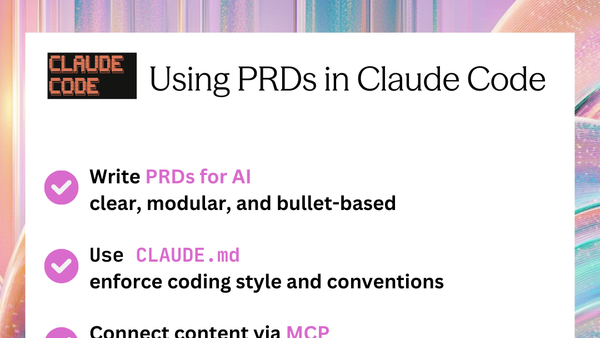
Best Practices for Using PRDs with Claude Code
Explore 2026 best practices for using PRDs with Claude Code to supercharge AI-assisted development. Learn how to structure PRDs for clarity, leverage ChatPRD’s MCP elicitation for real-time updates, and utilize agent teams and automation to align Claude Code outputs with your project vision.
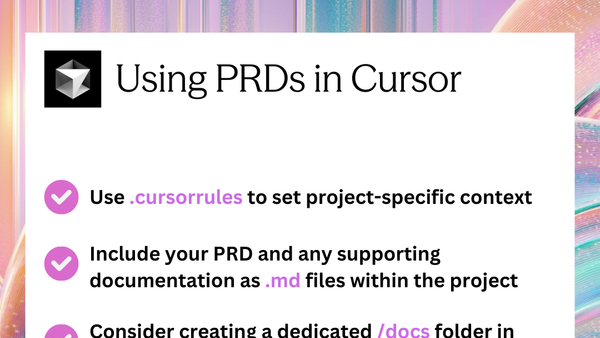
Best Practices for Using PRDs with Cursor
Explore best practices for using Product Requirement Documents (PRDs) with Cursor in 2026. Learn how to structure PRDs for optimal AI assistance with Cursor’s latest features, including Cloud Agents, Interactive UIs, and multi-model support, ensuring seamless alignment between product goals and development.
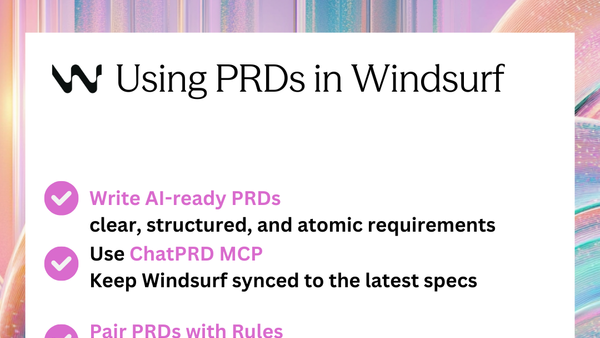
Best Practices for Using PRDs with Windsurf
This article explores best practices for using Product Requirement Documents (PRDs) with Windsurf, an AI-powered code editor, updated for 2026. By integrating a well-structured PRD via ChatPRD’s MCP, Windsurf leverages features like Cascade Agent and Fast Context to guide implementation, prevent refactoring churn, and ensure consistency across your project.
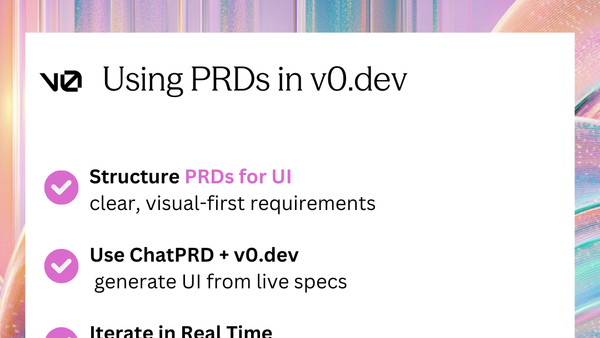
Best Practices for Using PRDs with v0.dev
Explore the 2026 best practices for using Product Requirement Documents (PRDs) with v0.app, the evolved AI-powered full-stack application builder. Learn how to structure PRDs for optimal UI and app generation, leverage ChatPRD integration, and utilize new features like agentic intelligence and database connections to streamline design-to-deployment workflows.

Writing PRDs for AI Code Generation Tools
Writing Product Requirement Documents (PRDs) for AI code generation tools in 2026 demands precision, structure, and tool-specific optimizations to harness cutting-edge capabilities. With agentic coding, massive context windows, and tools like ChatPRD, you can guide AI to deliver highly accurate code aligned with your vision. These advancements ensure PRDs are more critical than ever for seamless,高
Start shipping better products.
Join 250,000+ product managers who use ChatPRD to write better docs, align teams faster, and build products users love.